
A cautionary tale of why brands and politics don’t mix
The World Cup. The 250th Anniversary celebrations. Two of the biggest events being held this year are in the US but with political turbulence, heightened security and international tensions, it wouldn’t be a massive surprise to see brands display a bit of reticence around getting involved in sponsoring and advertising at these events.
But so far, it seems to be business as usual. Maybe it’s because both events offer a nice distraction from everything else going on in the world. Maybe it’s because according to a recent Ipsos poll, 59% of adults do not actively pay attention to adverts and sponsors during match broadcasts (although that does raise an interesting debate about why bother getting involved at all!) Or maybe it’s because brands know staying out of politics is a savvy move.
And you know what, they’re not wrong, as history is littered with examples of brands who voiced a political opinion and suffered the consequences.
When personal politics bleed into the brand
The year is 2016. The topic: Brexit. The venue: every Wetherspoons pub in the UK.
Sir Tim Martin, founder and chairman of JD Wetherspoons, was never a man to keep his opinions to himself. A long-standing Eurosceptic, he used the run-up to the EU referendum to turn his pub empire into a political campaigning machine.
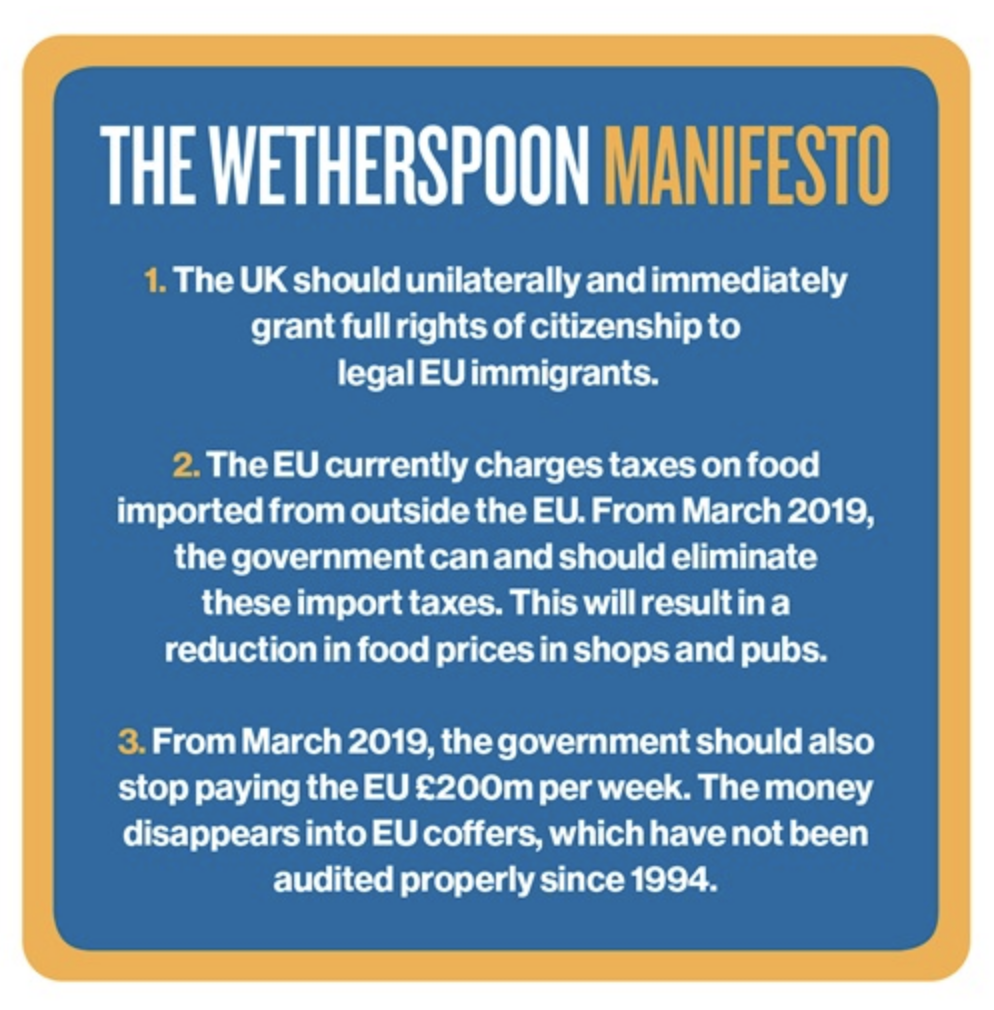
Pro-Brexit beermats, booklets and posters urging customers to vote ‘Leave’ were disturbed across Wetherspoon venues; the company’s in-house magazine championed the benefits of leaving the EU; well-known EU drinks such as Champagne and German beer were replaced with non-EU alternatives.
But the overt political messaging polarised customers. The campaign group “Spoons Against Brexit” made up of staff and customers, baulked against Martin using the pub chain to air his political views and demanded the company withdraw all “propaganda in favour of a hard Brexit”. Social media campaigns called for the chain to be boycotted, and investors were urged to reject the company’s annual report as the promotion had broken company law.
In 2018, Wetherspoons closed all their social media accounts. According to Martin this wasn’t because of the calls for boycotts or all the negative reviews, but because; “people spend too much time on Twitter, Instagram and Facebook, and struggle to control the compulsion.” Of course it was!
And while this reveals why founder’s shouldn’t use their company to air political views (who wants to go to a pub and be confronted by a manifesto on a beermat?!), the irony is, despite the online backlash and the boycotts, the brand’s core offering of affordable pints and food proved to be stronger than political differences and the financial impact was negligible.
But while Martin might have got away with it, Elon Musk has not been so fortunate. His overwhelming support for Donald Trump’s 2024 campaign (he was the largest financial backer), his brief role in charge of the Department of Government Efficiency (DOGE) and then actively campaigning for a far-right party in Germany, has not been good for the Tesla brand. Vandalism, protests, declining sales, Tesla owners using bumper stickers to distance themselves from Musk’s actions. The damage has been immense. And this reputational damage isn’t going to vanish overnight with Tesla now ranked at almost the bottom of the Axios Harris annual reputational poll. But then when you’re a trillionaire, do you really care?!
Loose lips really do sink ships
While a brand can’t necessarily control a founder’s political leanings or antics, they can be a bit circumspect when it comes to saying anything overtly political. Something New Balance learnt the hard way.
Enter Matthew LeBretton, New Balance’s head of public affairs, who in an interview with the Wall Street Journal, the day after the 2016 US election said, “The Obama administration turned a deaf ear to us, and, frankly, with president-elect Trump, we feel things are going to move in the right direction.”
Cue people burning their trainers, boycotts and a general consumer backlash. New Balance were quick to issue a statement saying the comment was about potential trade deals, not about being a Trump supporter, but is a clear indication of why brands should be very careful about what they say where politics are involved.
But it’s not just statements to the press that can cause long-term ramifications, so can seemingly innocent business decisions. In the months following the Brexit vote, the pound had fallen sharply, pushing up the cost of imports for companies who had fixed their supply contracts before the referendum. Unilever decided someone needed to absorb those rising costs, and that someone was Tesco. Unsurprisingly, Tesco gave them a hard no and pulled Unilever products such as PG Tips tea, Pot Noodles and Marmite from its website.
#Marmitegate, #Marmageddon and #Marmexit exploded on social media, with Tesco seen as the defender of the British shopper and Unilever as the bully boy using Brexit as an excuse to raise prices. Both companies saw their share prices fall on the day the story broke, and shoppers threatened to boycott all Unilever goods.
What’s interesting about this example is that neither Tesco nor Unilever had said a single political word. This wasn’t a case of a CEO backing a political party or a brand sticking a slogan on a beer mat. It was a commercial pricing dispute, the sort that happens between supermarkets and suppliers all the time. But the timing meant it landed in the middle of the most politically charged atmosphere Britain had seen in decades, and both brands immediately became part of the Brexit debate whether they wanted to be or not.
The dispute was quickly resolved and the real winner, of course, was Marmite who saw sales shoot up by 61% in one week!
These examples could explain why brands haven’t been overly political around the World Cup. One of the reasons New Balance and Unilever were hit with a consumer boycott is because social media fanned the flames, amplifying the strong emotions felt around the comments and causing initial market reactions to go viral quickly. And with research showing social-media organised boycotts can trigger sales drops of up to 8%, brands really can’t afford to make any mistakes especially on such a global stage.
And if you’re going to get political, take a proper stand
And while we’d probably advise it’s wise not to take a stance on mainstream politics, there is a caveat to that. If it’s on brand and you mean it, then it’s worth the chance.
Ryanair’s whole brand identity is built on cheeky humour, and they are known for roasting both their customers and competitors, so this response to Keir Starmer’s resignation which garnered almost 10,000 likes in the first 90 minutes, is bang on brand.
this didn’t age well https://t.co/Dny9AY3qqX
— Ryanair (@Ryanair) June 22, 2026
And Patagonia saw a similar social media surge with their 2020 “Vote the Assholes out” campaign. The slogan which referenced the Trump Administration’s reversal of over 100 environmental protections was added to a tag in a batch of shorts which were then released into the market for consumers to find. And when they were, they unsurprisingly led to a social media storm.
The irony is this wasn’t a planned marketing stunt. It was the idea of one designer, who was so clear about Patagonia’s mission and values that he went ahead without getting approval from the executive team. But it worked because Patagonia lives by its environmental credentials, and because it reflected their whole brand ethos.
And you realise how good that campaign was when compared to Gap’s toe-curling attempt. Gap decided they would try and bring America together with a hoodie, blue on one side and red on another. Just zipping it up would unite the nation. The criticism was brutal.
And that’s why brands shouldn’t try and please everyone and why having the courage of your convictions is so important. Marketing is about appealing to your target audience, and by definition this can’t be everyone. But admittedly, that’s easy to forget when a consumer backlash takes hold.
Back in 2023, Target released a whole host of merchandise to celebrate Pride Month. Within days, employees had started to receive threats, misinformation about them selling ‘tuck-friendly’ products abounded online, and musician Forgiato Blow released a song imaginatively entitled “Boycott Target.”
Target acted quickly to this conservative backlash withdrawing a range of products and moving merchandise to the back of stores. This only served to anger the Target customers who celebrate Pride, who said they were caving in to extremists. Sales dropped, they experienced flat revenues through 2024, and investor lawsuits were filed claiming the board misled the market on its social policies. And all over a “too queer for here” tote bag.
And that’s the key takeaway. If you are going to have an opinion about politics, best marketing practice shouldn’t fly out of the window. You still need to appeal to your target audience; you still need to be on brand; and you still need to get your timing right. And that might mean accepting that sometimes it’s just better to say nothing at all.